We left
Pickwick, TN, and found ourselves on US-64, following the original Trail of
Tears. My heart ached as Mom educated me
on the tragic saga of our American Indians, sometimes forcibly torn from their
homelands and given false promises of new lands (Territory of Oklahoma). Sadly, those promises were broken—all by the
same Federal government so righteous on slavery, yet so brutal and intent on
annihilation of a culture they classified as “barbaric.” (Mom often chatted with a Lakota vendor at
Crazy Horse Memorial when we work-camped there. He always wore a shirt bearing the phrase,
“Sure you can trust the government, just ask an Indian.” ‘Nuff said.)
After driving
on Tennessee roadways that felt like we were riding a bronco, we traversed down
a treelined country road to arrive at Featherstone Farm, a Harvest Host in
Mayfield, KY. They say they can handle
45-foot RVs. However, if you are a bigger rig, you must access the property from the East. Coming from the West is a 45-degree-angle right turn with a barn 25 feet
in front of you! For once, Gretchen gave
us sound advice, so we had no problems.
The field is firm and open but contains heavy swales. Thank goodness we detached the Rambling RV
Rat Pack Rubicon before entering. We enjoyed very
pleasant hosts, lovely grounds with short hiking trails, and lots of fun animals. But there really is not much to buy in their
gift shop for full-timer RVers like us (mostly antiques, knick-knacks, and the
like. Mom purchased a $20 candle and
some home-sewn sachets.)


Since we had the Jeep detached, we went to see the Wooldridge Monument, a Roadside America attraction located in Maplewood Cemetery, just 6 miles from our Harvest Host site. Mr. Wooldridge (perhaps eccentric or just a bachelor with money to burn) had statues carved and erected at his burial plot of himself and those that he loved (his siblings, his mother, even his pets!) This was not an act of his Last Will & Testament but instead done 8 years BEFORE Mr. Woodridge died in 1899. Known as the “Strange Procession That Never Moves”, his monument was featured on Ripley’s Believe It or Not. It must be spooky to see this monument on a foggy night!
 |
| "Strange Procession That Never Moves." |
While downtown, we learned Mayfield was in the direct path of an EF-4 tornado in 2021, killing 22 residents. (Fortunately, Featherstone Farm was not impacted). Another EF-1 tornado on May 28, 2024, just missed hitting Mayfield (but nearby towns were not so lucky). Evidence of the 2021 tornado still exists: entire City blocks void of any buildings and the wonderful disaster relief organization, Samaritan’s Purse, seen all over town (the non-profit is helping with the rebuild of 110 Mayfield-area homes).
 |
| Entire City blocks were like this, void of buildings. |

The next day we
entered Illinois, with an overnight stay at our Harvest Host, the Route 66
Skyview Drive-In in Litchfield. Once
we figured out we must enter via the exit, we were settled in quickly and
easily.


Normally, we wouldn’t detach the Jeep, but this is Route 66! We just had to take a ride on the Mother Road in Illinois, having cruised Route 66 previously in several other states. Ironically, we ended up in Livingston (not the one in TX) at the Pink Elephant Antique Store and Tasty 50's Style Diner. What a treat to take a stroll down Memory Lane, marveling at all the novelties and antiques inside the store. But outside was even more enjoyable than inside! Elephants, alien spaceships, Marilyn Monroe, giraffes, heck even a Donald J. Trump statue adorn the grounds (sure didn't expect to see him here). Such fun!


 |
| Hanging with Chipmunk pals Alvin, Theodore, and Simon. |


We returned home and I got a front row seat for the movie show. Then Dad explained to me that it was Tuesday, and that the Skyview only has movie shows on weekends (no wonder no one else was here!) At first, I was so disappointed. But as I watched the colorful sunset, I realized I witnessed a far superior show from our Creator than I would have seen on the screen.


The next day we
proceeded to the Illinois State Fairgrounds in Springfield, our “home” for the
next 3 nights. All sites, whether full
hook up or dry camping, cost $20/night.
Since so few people were present, the manager suggested we just park
parallel rather than worry about backing in.
Sounds good to us! We thanked him
with a 6-pack of Yuengling. He was
thrilled since it is a favorite brand of his but not sold in the area.
These Fairgrounds are HUGE, and we found lots of fun stuff to do! We purchased produce at their Farmers’ Market, visited their Route 66 Experience Exhibit, and enjoyed the Midwest Charity Horse Show that was ongoing. One night we were subjected to a huge thunder/hailstorm. But once it blew by, we were treated to a fantastic rainbow and sunset.


 |
| Route 66 Experience Exhibit was great! |


 |
| Midwest Charity Horse Show. |


The Museum is wonderful! It presents facts in an interesting and untraditional way. Utilizing holographs and high-tech theatrics, its two main features demonstrate the importance of artifacts, research, and maintaining history. Then you walk through life-like representations of various stages of Abe's life. (It is almost like going to a wax museum.) For you nomadic Moms who homeschool, this place is a sure winner to get your youngsters interested in a history lesson.
The exhibits
give insight into the turbulent life of a young Abe Lincoln to the heavy
responsibilities on his shoulders as President. Abe came from a poor but humble frontier family.
When his Mom died, his father remarried.
He and his Stepmom shared an affectionate relationship, but now having step-siblings
meant a more crowded 1-room cabin and more mouths to feed. So, Abe was required to work to earn money
for his household. With his tall
physique and strong athleticism, Abe became a match-winning wrestler as a teen (he even was honored posthumously with an award by the National Wrestling Hall
of Fame!)
He attended school on a rare occasion, but he learned to read and write through self-education. He even composed short poems and stories, and as we know from letters he penned, he became quite eloquent. He studied law and arrived in Springfield to put his degree to work, eventually opening his own firm.

He courted Mary Todd, asked for her hand in marriage, then he reneged on the engagement. But in the end, love prevailed. They were married and had 4 sons. The boys were very free-spirited and rambunctious (Abe and Mary were not known as good disciplinarians. But then again, Abe acted as badly as the children when it came to raucous play). Abe and Mary suffered great tragedy, with 3 of their 4 children passing away at young ages (Eddie, age 4; Willie, age 12; Tad, age 18), a heartache even the most resilient parents would find difficult to withstand.
 |
| Mary Todd had a lovely wardrobe. |
 |
| These kids needed a time out! |
 |
| A Museum scene depicting the passing of young Eddie. |
I learned Abe was a great lover of cats! He would bring home any stray he found in Springfield. The Lincoln family also had a dog Fido.
Abraham Lincoln had dabbled
in politics, serving as State Legislator and U.S. Representative before running
for the Presidency in 1860 due to his staunch anti-slavery beliefs. Winning the Presidency placed a huge burden
on Lincoln’s shoulders, for shortly thereafter the Confederate States of America
formed and the Civil War commenced. Many
felt he was unfit for the job and disagreed with his position, making Abe the
subject of unflattering political cartoons.
This was particularly true when he issued his Emancipation Proclamation
in January 1863. On its surface, it
sounded like he was freeing all slaves.
Who could ask for more? But the
devil was in the details. The
Proclamation only freed the slaves in Confederate states. Owners of slaves in the North and certain
Union-controlled areas were exempt. Effectively,
very few slaves were freed by this act.
But the Proclamation did serve to enlist the Black freedmen into Federal
armed forces.
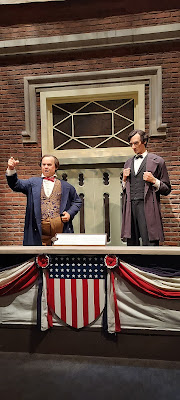 |
| Douglas/Lincoln Debate |
 |
| Innovative exhibit puts the Presidential Election of 1860 into modern times. |
 |
| The Lincolns go to Washington, DC. |
 |
| Just a small sampling of the unflattering caricatures/political satires aimed at Abe. |
 |
| The toll of the war is evident in these photographs of Lincoln. The bronze casts represent his death masks. |
John Wilkes Booth, a Confederate sympathizer upset that Lincoln wanted to grant slaves the right to vote, assassinated Abe on April 11, 1865, while Mr. and Mrs. Lincoln viewed a theater performance at Ford’s Theater in Washington, DC. Wow, so much heartache, carnage, and hatred.
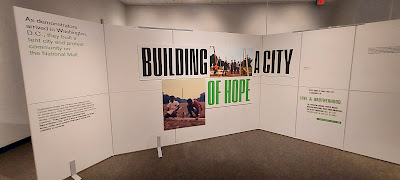
The Museum also had an interesting special exhibit on the efforts of Martin Luther King, Jr. and his 1968 non-violent Poor People's Campaign. The campaign had an admirable goal: "people helping people to help themselves." This Rambling RV Rat is too young to have known much about these turbulent times. But it is evident from this exhibit that those who participated in Resurrection City put their lives on hold, sustained harsh weather, and endured hardship to raise awareness of the need for jobs, affordable housing, accessible healthcare, and a better life.
After all I learned at the Museum, it seemed fitting that we visit the tomb where Abe, Mary, and 3 sons are buried. We walked over from the Fairgrounds after visitation hours, so we could not go inside the tomb. But construction is going on there anyway.

 |
| The original tomb of Lincoln while construction of the final resting place was ongoing. |
 |
| The final resting place of Abe, Mary, and 3 sons (oldest son Robert is not buried here). |

 |
| This little lass also was visiting Lincoln's original tomb. |
Outside the tomb, there is a bronze bust of Lincoln created by Gutzon Borglum (of Mt. Rushmore fame). It is said that rubbing Abe’s nose brings good luck!

On another day, we walked through the City, taking in some other areas of interest.
 |
| The Capitol building in use 1839-1876. |
 |
| The current Capitol building. |
 |
| The Governor's Mansion. |

 |
| This building housed Abe's original law office. |
 |
| Me and Abe shooting the breeze. |
Then we headed to the Lincoln Home National Historic Site. Like Mt. Rushmore, entry is free, but you must pay to park. This wonderfully-preserved piece of history is the home where Mary, Abe, and their 4 sons lived. It is also the home where young Eddie died. The home features many original furnishings, including the wood burning cooking stove in the kitchen and Abe’s desk in the master bedroom. The Historic Site includes several other period homes along the cobblestone street, providing an excellent representation of what life would be like for the Lincolns and their neighbors.
 |
| The task of restoration was made easier... |
 |
| ...by having this 1860 photo of the home. Abe and son Willie can be seen on their property behind the fence. |
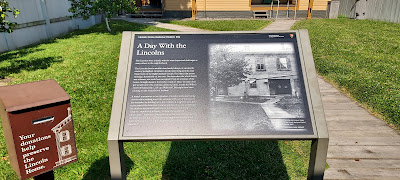 |
| Photo from 1865 of the back of the home... |
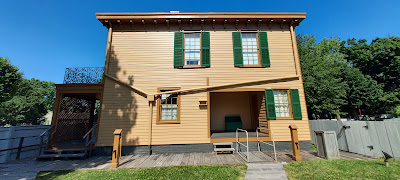 |
| ...and what you see today. |
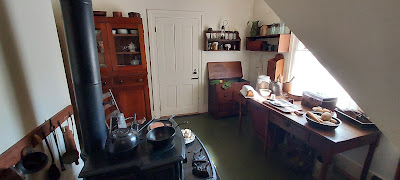 |
| Kitchen with original stove. |
 |
| The master bedroom wallpaper is a replica of the pattern Mary Todd chose personally for this room. |


 |
| Photos of 3 of the 4 Lincoln sons. Eddie, the youngest who died in this home, is not pictured. |
 |
| Some of the other... |
 |
| ...period homes... |
 |
| ...within the Historic Site. |
After lunch at LuLu’s Diner, we headed to the Dana-Thomas House, an incredible home designed by Frank Lloyd Wright. Having visited Wright’s Falling Waters, we were thrilled to find this fine example of Wright’s early years of architectural/interior work.
Susan Lawrence
Dana inherited the riches of her father, a successful politician and
businessman. As a supporter of the suffragette movement and an anti-slavery
activist, she surrounded herself with the influential and prominent upper crust
of Springfield. Hence, she wanted to
impress her guests when she entertained.
She hired Wright in 1902 (just 10 years into his career) to
renovate. She gave him an unlimited
budget (to this day, no one knows the true cost of the house) and free reign
for the design with one exception: she wanted a big, striking, show-stopping entrance (which is
something Wright would not do normally. His
signature design was compress and release, small doorways that opened up to big
open spaces.)


This House is amazing, awesome, absolutely gorgeous! Unfortunately, they do not allow any photographs of the interior during tours. But they do post a few pictures on their website (https://dana-thomas.org), which is where all these interior photos have been extracted. (Personally, I don't think the photos do it justice.)
“Levels, Jerry, levels”, said Kramer on Seinfeld when talking about redesigning his apartment. Well, levels were Wright’s specialty. In fact, he is known as the pioneer of split-level designed homes. The Dana-Thomas House consists of 16 levels within 12,600 square feet.


This House was fully electrified (one of the first for the time period), contained hidden radiator heat, gorgeous red oak floors complemented with white oak furniture, and it boasts the largest collection of Wright’s art glass. Wright liked to bring local nature into his Prairie design, so the recurring theme of butterflies, chevrons, and sumacs is throughout the house. The home contains the unusual feature of not 1 but 2 barrel-arched ceilings. (Wright used this barrel-arch ceiling in only 3 rooms within the 400 homes that he ever designed).


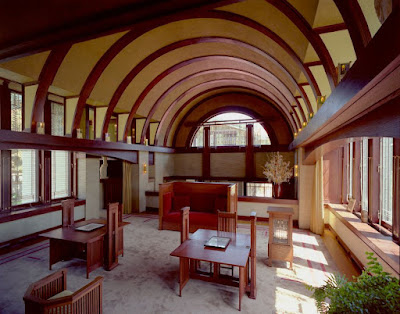
Sadly, Susan
Lawrence Dana spent so much money on her extravagant home and her charitable
and social justice endeavors, that the home and its contents were taken from
her in 1943 to pay for her debts. She died
penniless in 1946 at age 84.
Fortunately,
publisher Charles Thomas and his wife Nanette purchased the home in 1944 for
$16,000, bought back many furnishings, and maintained its integrity. They used it as their publishing company’s
headquarters until 1981, at which time it was sold to the State of Illinois.
A tremendous
tour of a spectacular architectural work by an entertaining, well-informed
docent makes this a Rambling RV Rat 5-cheese experience. Though the tour is free with reservations required, I gladly donated some cheese money to support this
superb example of Wright’s Prairie-style.
And that, my
friends, is what I call a perfect way to end a visit to Springfield!
Talk to you again soon!