Revisiting Charleston this year was not on our original
itinerary. However, we decided our Civil
War battle tour would not be complete without a stop at Fort Sumter. Fort Sumter has the distinction of being
where the first shots of the Civil War were fired.
To facilitate our Charleston visit, we reserved a site at
James Island County Park. We had a
90-foot pull-through site that was nearly twice as wide as most RV sites,
providing us plenty of privacy. We
enjoyed the hiking/biking trails and the natural setting. Of course, all this came to us at the premium
price of $82/night!
 |
| Our site at James Island County Park was extra long and twice as wide as most RV park sites. |
 |
| The hanging moss added character to the trees. |
 |
| James Island County Park hosts a Drive-Thru Christmas Light Show. I got a sneak peek! |
We drove into downtown Charleston, reacquainting ourselves
with an area that we visited twice previously. No matter how often I revisit somewhere,
though, I always learn something new. Here in Charleston, I discovered that the
height of any building within the city cannot exceed the height of the tallest church steeple. Therefore, you won’t see
many modern towers in Charleston’s skyline.
We took a tour of the campus of The Citadel, one of 6 senior
military colleges in the U.S.
Established in 1842, its cadets participated in several Civil War
engagements. Half of its current student
body participates in the Cadet program, but the college offers non-military
degrees as well. Considering the Citadel
did not admit women into its Cadet program until 1995, I was amazed at how many
women are enrolled currently—you go, girls!
 |
| We were blessed to hear a pianist practice when we popped into the Chapel. |
 |
| All the Chapel's beautiful stained glass windows were donated by various graduating classes. This window was presented by the Class of 1890 over 130 years ago! |
 |
| The Chapel Bell Tower and Memorial Gardens. |
And now for my Rambling RV Rat simple synopsis of Fort
Sumter as well as its role in the Civil War:
Construction of Fort Sumter began in 1829, following the War
of 1812 between the United States and England.
Construction suffered several delays due to funding and a land title
dispute. Consequently, the interior was
not fully complete and some armaments were not fully functional when South
Carolina seceded from the United States after Abraham Lincoln won the election
of November 1860. Lincoln, a staunch
abolitionist, announced plans to strengthen and resupply the fort, which
irritated the Confederate State of South Carolina. Hence, South Carolina demanded the Union
evacuate Fort Sumter. When U.S. Major
Robert Anderson refused, the newly-formed Confederate army, under the direction of
its first General, P.G.T. Beauregard, began bombarding the fort. This continued for 34 hours until U.S. Major
Anderson surrendered on April 14, 1861, taking the fort’s flag with him.
 |
Our boat--and the water fowl--came in for a landing at Fort Sumter.
 | View of Charleston from the boat.
|
|
 |
| Per this model, Fort Sumter was a 5-sided structure. It was built 55-feet above sea level. |

 |
| Can you spot the projectile lodged in the left side of the brick wall? |
 |
| Slave labor was used to make the bricks and build the fort. That center brick shows the fingerprints of an enslaved African who toiled here. |
 |
| This cannon was excavated in 1959 but dates back to the 1860s. |
Despite the Union’s efforts to regain the position,
the Confederates maintained control of Fort Sumter until they abandoned it in
February 1865. After the Union won the Civil War, U.S. General Anderson returned to Fort Sumter to raise the flag he removed exactly 4 years earlier. But this ceremonious incident received little
fanfare. You see, it occurred the same
day as President Lincoln’s assassination.
As we traversed the
Harbor via boat to and from the fort, the Park Rangers provided guests an
informative and interesting narrative, which helped me immensely in earning
another Junior Ranger badge.
As we left the Visitor/Interpretive Center, we walked along
what was once Gadsden’s Wharf. That’s
where I learned some disturbing information that made me quite sad. This wharf was the only one in Charleston
authorized to engage in the trans-Atlantic slave trade between 1806 and 1808. It is said some 30,000 captured Africans
disembarked at this wharf at that time. This was many more slaves than what were needed, causing the
purchase prices of slaves to plummet (supply and demand economics applied
even to slavery!) Like any other of
their “products”, the merchants put their slaves in warehouses or left them
outside while they waited for prices to rise!
Subject to malnutrition, little clothing, and exposure to the elements,
hundreds of slaves perished here. I said a little prayer, asking God to forgive
our Country’s past transgressions and for the souls of those who died here.
We were preparing to depart the campground at 10:19 a.m. for
an 11 a.m. check-out time, when what to my wonderous eyes did appear: a flat
tire! Somehow, we picked up a 2-inch
brass nail! Thank goodness Dad is one
handy-dandy guy. Rather than calling
Coach-net, our roadside assistance provider, Dad pulled out the spare, changed
the tire, and had us out of our site at 10:53 a.m.! (I think he is practicing for Nascar’s pit
row!)

We headed to our overnight Harvest Hosts, Bowers Farm, in
Pomaria, South Carolina, where I enjoyed the sheep, chicken, geese, and horse
who reside here. The Farm sells meats,
but the products we wanted to purchase were out of stock. Anyway, at 95 degrees that day, my cheese was
melting, and the humidity was making me feel like a sticky bun. We were thankful Bowers Farm offers electric
hookups, for which we gladly forked over the $20 fee. (The Bowers family also owns a
full-hook-up lakeside campground about 20 minutes away if you prefer being
around people rather than farm animals).
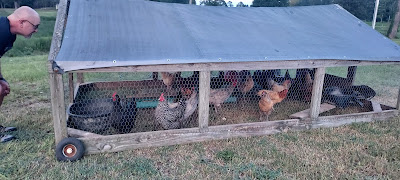 |
| Dad wanted to play peek-a-boo with the chickens, but they wanted nothing to do with him. How smart is it that the Bowers put this chicken coop on wheels, so it can be moved from location to location! |
On to Barefoot Acres in Fountain Inn, South Carolina, our
Harvest Hosts for that evening. Gretchen,
our GPS, gave us directions for access via a right turn, which would have been
tight, tight, tight—had Dad listened to her.
But Mom can attest that Dad is quite versed in ignoring what women tell
him, so he came in from the other direction with no problems. We were instructed by the welcoming hosts to
park in a big, open field that gave us plenty of room to turn around when we exited. There is a covered picnic area
for guests’ use nearby (though no table is provided.) This location dubs itself as a farm and
adventure park. However, their zip line
has been closed since 2023. The hosts have been creating some hiking and mountain bike
trails, which Mom was happy to explore. Mom also got excited when she
saw their “certified roadside market” sign.
She had visions of restocking us with fresh-picked veggies. But the market had scant produce for
purchase, instead offering promotional items like hats, T-shirts, keychains,
etc. We made our purchases, then I went to meet the
rabbits, donkeys, sheep, and young piglets who call Barefoot Acres their home. We got parked and settled just before
the rain hit, which unfortunately put a damper on the wedding that was taking
place on the grounds. Too bad the wedding wasn't the next day--we had glorious sunshine.

Well, it is time for my cheese break. But I’ll talk to you again soon!